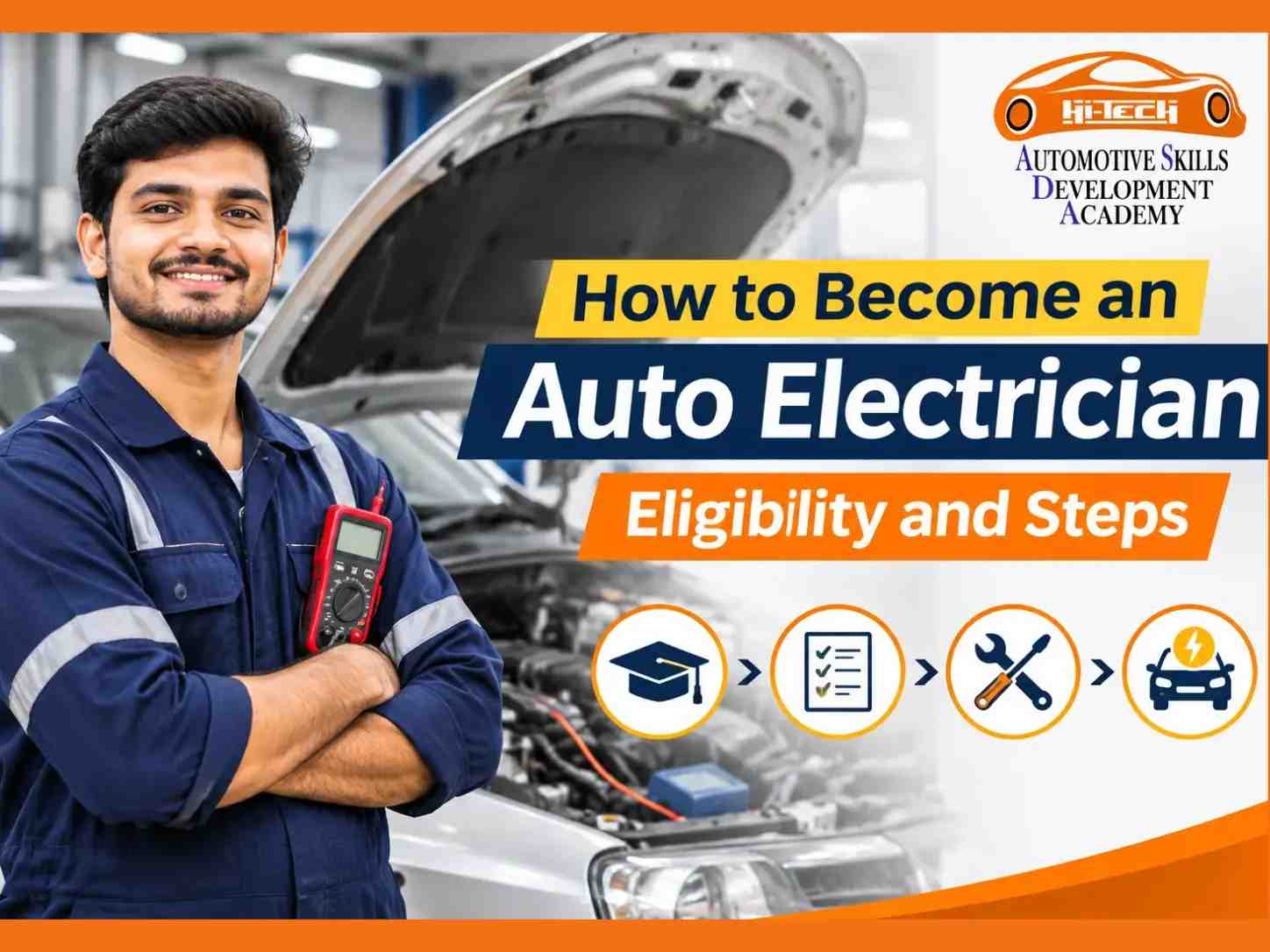
How to Become an Auto Electrician: Eligibility and Steps
Cars today run on wires, sensors and batteries. Someone has to fix them. That person is an auto electrician.
Want this job? You can start with a short Electrical Training Course in Delhi. This guide shows you the eligibility, the steps, the cost of time, and the jobs you can get.
Quick answer: To become an auto electrician, you pass Class 10 or 12, join a good auto electrical course, learn by doing real repair work, earn a certificate, and then start work in a garage or service centre. Most of the people finish in 3 months to 2 years.
What Is an Auto Electrician Course in Simple Words?
An auto electrician course teaches you how to fix the electrical parts of a car. Think of the car’s electrical system like the nerves in your body. Wires carry power. Each part uses that power to do its job. If one part stops working, the car may not start. In this course, you learn about the car wiring system, the vehicle battery, lights, horn, wipers, and fuses. You also learn car electrical repair. That means you find the fault, fix it, and test the car again. You don’t guess. You check each part and solve the problem step by step. Every car needs an electrician at some point, so skilled people always find work. Anyone can join. You can be a student, a mechanic, or a job seeker.
An auto electrician finds and fixes electrical problems in cars, bikes, and trucks. Every day brings new faults to solve, so no two days feel the same.
A normal day may look like this:
- Check why a car will not start: You listen to the problem, then test the battery, fuses, and wires to find the cause.
- Do Car Battery Replacement: You remove a weak battery and fit a new one the right way.
- Fix broken wires through Automotive Wiring Repair: You find cut or burnt wires and repair them so power flows again.
- Do Alternator Repair: When the battery does not charge, you check the alternator and fix it.
- Do Starter Motor Repair: When the engine does not crank, you test the starter motor and repair it.
- Use a scanner for Vehicle Electrical Diagnostics: You plug in a scanner, read the error codes, and find the fault fast.
- Test lights, fuses, switches, and sensors: You check each small part so the whole system stays safe.
You solve small problems, like a blown fuse. You also solve big problems, like a full wiring fault. You use tools, test each part, and fix the real cause. Every day feels different, and every fix makes a car safe to drive again.
Who Can Join an Auto Electrician Course?
Most students need to pass Class 10 to join. Some diploma courses ask for Class 12.
|
Requirement |
Details |
|
Minimum age |
16 years or more |
|
Education (certificate course) |
Class 10 pass |
|
Education (diploma course) |
Class 12 pass (some institutes accept Class 10 + ITI) |
|
ITI students |
Can join after Class 8 or Class 10 (Electrician or Mechanic Motor Vehicle trade) |
|
Subjects |
Science and Maths help, but they are not compulsory |
|
Basic skills |
Simple reading, writing, and math |
|
Interest |
Love for cars and hands-on work |
|
Physical fitness |
Good eyesight and normal colour vision, so you can tell wire colours apart |
|
Documents |
Age proof, marksheet, ID proof, passport-size photos |
|
Science or engineering degree |
Not needed |
|
Who can join |
School pass-outs, working mechanics, job seekers, career changers, and future workshop owners |
You only need the will to learn.
Rules can change from one institute to another. So always check the entry rules, fees, and course length before you apply
How Long Is an Auto Electrician Course?
An auto electrician course takes 3 months to 3 years. The duration is determined by the kind of course you select.
|
Course Type |
Usual Time |
What You Learn |
Best For |
|
Short certificate course |
3 to 6 months |
Basic wiring, battery care, lights, horn, fuses, and simple repairs |
Quick skill building and a fast start in a garage |
|
Advanced certificate course |
6 to 12 months |
Charging and starting systems, scanner use, and Vehicle Electrical Diagnostics |
Mechanics and job seekers who want deeper skills |
|
ITI trade course |
1 to 2 years |
Electrical theory, workshop practice, and hands-on repair training |
A strong base for government and private jobs |
|
Diploma in automobile |
Up to 3 years |
Engines, electrical systems, vehicle technology, and workshop management |
Full career growth in the auto field |
|
What changes the time |
Varies |
Full-time or part-time batches, practical hours, internship, course level, and your attendance |
Pick the format that fits your schedule |
Short on time? Pick a short certificate course. Want a bigger career? Pick a diploma.
What Will You Learn in the Course?
You will learn how a vehicle’s electrical parts work and how to repair them. A good course covers these topics:
|
Topic |
What You Learn |
|
Automotive Electrical System |
How power flows from the battery to every part of the vehicle |
|
Wiring Diagrams |
How to read symbols, colour codes, and circuit paths |
|
Car Wiring System |
How wires, switches, and connectors link every part together |
|
Vehicle Battery |
How a battery stores power and gives it to the car |
|
Car Battery Replacement |
How to remove, fit, and test a battery safely |
|
Alternator Repair |
How to find charging faults and fix them |
|
Starter Motor Repair |
How to fix a starter motor when the engine does not crank |
|
Automotive Wiring Repair |
How to find cut or burnt wires and repair them |
|
Vehicle Electrical Diagnostics |
How to use a scanner and a multimeter to find the exact fault |
|
Auto Electrical Troubleshooting |
How to solve a problem step by step, from symptom to fix |
|
Safety Rules |
How to protect yourself and the car, with safe tools, insulated gloves, and correct battery handling |
What Tools and Equipment Will You Use in Training?
You will use hand tools, test tools, and real car parts. Here are the common ones:
|
Tool |
What It Does |
Where You Use It |
|
Multimeter |
Checks voltage, current, and resistance |
Testing batteries, wires, fuses, and switches |
|
Test light |
Shows if power is flowing |
Quick checks on lights, fuses, and circuits |
|
Battery tester |
Checks battery health and charge level |
Deciding if a battery needs charging or replacement |
|
Wire stripper and crimper |
Removes wire cover and joins wires with connectors |
Automotive Wiring Repair |
|
Soldering iron |
Joins wires firmly with solder |
Fixing broken wires and loose joints |
|
Scan tool |
Reads fault codes from the car |
Vehicle Electrical Diagnostics |
|
Spanner and screwdriver sets |
Open and fix parts |
Alternator Repair, Starter Motor Repair, and Car Battery Replacement |
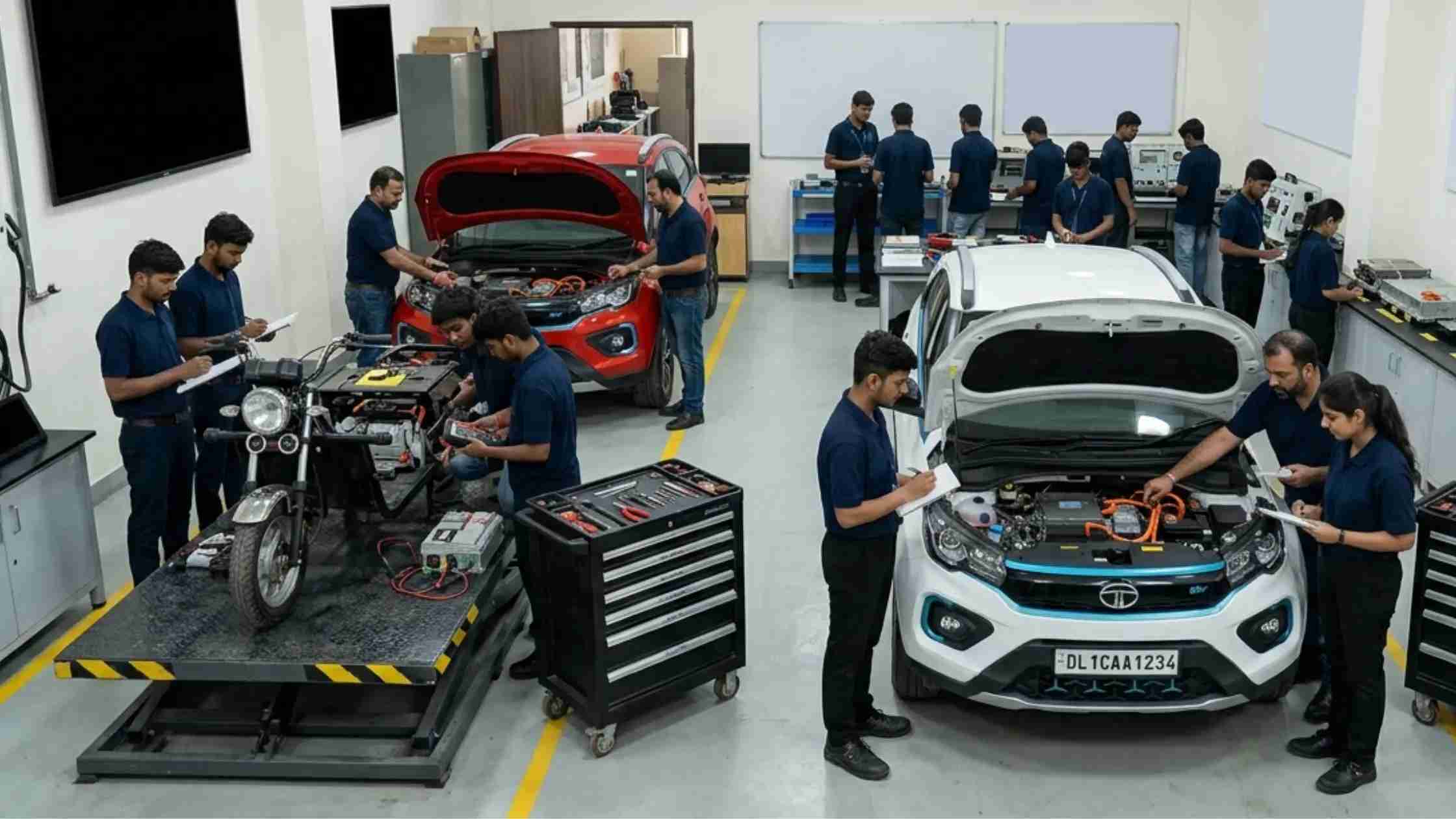
You also work on real car parts, such as engines, batteries, alternators, and starter motors.
A good institute lets you touch and repair these parts yourself. You don’t just watch. You learn by doing.
Before you join, ask the institute if you get your own tool practice and how many real vehicles you can work on.
Is Practical Training Part of the Course?
Yes. A good auto electrician course gives more time to practical work than to theory.
Theory tells you why a part fails. Practice shows you how to fix it. You can only learn this job with your own hands.
|
Practical Area |
What You Do |
|
Workshop practice |
Use tools, test parts, and repair faults on a real bench |
|
Live vehicle training |
Work on running cars, bikes, and trucks |
|
Trainer support |
Get guidance from an expert at every step |
|
Wiring practice |
Read diagrams, trace circuits, and fix broken wires |
|
Diagnostics practice |
Use a scan tool and multimeter to find real faults |
|
Repair practice |
Do battery, alternator, and starter motor jobs from start to finish |
|
Safety practice |
Handle batteries and live circuits the right way |
A good course often keeps 60% to 70% of the time for practical work. Always confirm the exact split with the institute.
What Is the Difference Between a Certificate, Diploma and ITI?
A certificate is the shortest course. A diploma is longer. ITI is a government-recognized trade course.
|
Point |
Certificate |
Diploma |
ITI |
|
Time |
3 to 12 months |
Up to 3 years |
1 to 2 years |
|
Focus |
One skill, fast |
Wide subject base |
Trade skills with practice |
|
What you learn |
Wiring, battery care, repair, and diagnostics |
Engines, electrical systems, and vehicle technology |
Electrical theory and workshop work |
|
Entry level |
Class 10 pass |
Class 10 or Class 12 pass |
Class 8 or Class 10 pass |
|
Best for |
Quick job start |
Higher study and growth |
Government and private jobs |
|
Recognition |
Institute certificate |
Board or university diploma |
Government-recognised |
How to choose:
-
Want to start work fast? Pick a certificate.
-
Want to grow and study further? Pick a diploma.
-
Want a government-recognised trade? Pick ITI.
Check that the institute is approved before you pay any fees.
What Jobs Can You Get After the Course?
You can work in garages, service centres, workshops, and fleet companies. You can also start your own shop.
|
Job Role |
What You Do |
Where You Work |
|
Auto electrician |
Find and fix electrical faults in vehicles |
Garages and workshops |
|
Car electrical technician |
Repair wiring, lights, switches, and sensors |
Car service centres |
|
Battery and charging system technician |
Test, charge, and replace batteries, and repair alternators |
Battery shops and service centres |
|
Vehicle diagnostics technician |
Use a scan tool and multimeter to find the exact fault |
Brand showrooms and advanced workshops |
|
Service centre electrician |
Handle electrical jobs on customer vehicles every day |
Authorised service centres |
|
Workshop supervisor |
Lead a team, assign jobs, and check repair quality |
Large garages and fleet companies |
|
Self-employed car electrical repair expert |
Run your own shop and serve your own customers |
Your own workshop or mobile service |
How can you grow in this field?
-
Start as a helper or junior technician.
-
Build skill and become a senior auto electrician.
-
Move up to supervisor or workshop manager.
-
Open your own workshop when you feel ready.
Choose an institute that gives real workshop practice, skilled trainers, and a valid certificate.
|
What to Check |
What to Look For |
|
Trainers |
Real garage experience, not just classroom teaching |
|
Workshop |
Live cars, bikes, and trucks you can work on yourself |
|
Syllabus |
Covers Alternator Repair, Starter Motor Repair, and Vehicle Electrical Diagnostics |
|
Batch size |
Small batches, so every student gets personal help |
|
Certificate |
Valid, approved, and respected by employers |
|
Job help |
Support with interviews, resume building, and placement |
|
Fees |
All costs clear from day one, with no hidden charges |
Quick tips before you join:
-
Visit the institute and see the workshop yourself.
-
Talk to past students about their experience.
-
Ask how many hours you spend on practical work.
-
Get the fee details and course length in writing.
If you search for an Electrical Training Course in Delhi, use the same checklist. Many institutes look good online, but the workshop tells the real story. Visit two or three places, compare them, and then choose the one that gives you the most hands-on practice.
Final Words
Becoming an auto electrician is a clear path. First, pass Class 10 or Class 12. Next, pick the right course, whether it is a certificate, diploma, or ITI. Then practice a lot in the workshop, on real vehicles. Once you finish, collect your valid certificate and start work in a garage, a service centre, or your own workshop. Cars will always need electrical repair, and modern vehicles use more electronics every year. So skilled auto electricians will always find work. Ready to start? Choose a trusted Electrical Training Course in Delhi and take your first step today.
FAQs
Can I become an auto electrician after Class 10? Yes. Most short courses and ITI courses accept Class 10 pass students.
How long does it take to become an auto electrician? It takes 3 months to 2 years, based on the course you pick.
Is an auto electrician course good for a career? Yes. Every car, bike and truck has an electrical system. So the demand stays strong.
What does an auto electrician fix? An auto electrician fixes batteries, alternators, starter motors, wiring, lights and sensors.
Do I need practical training? Yes. Hands-on work is the best way to learn this skill.