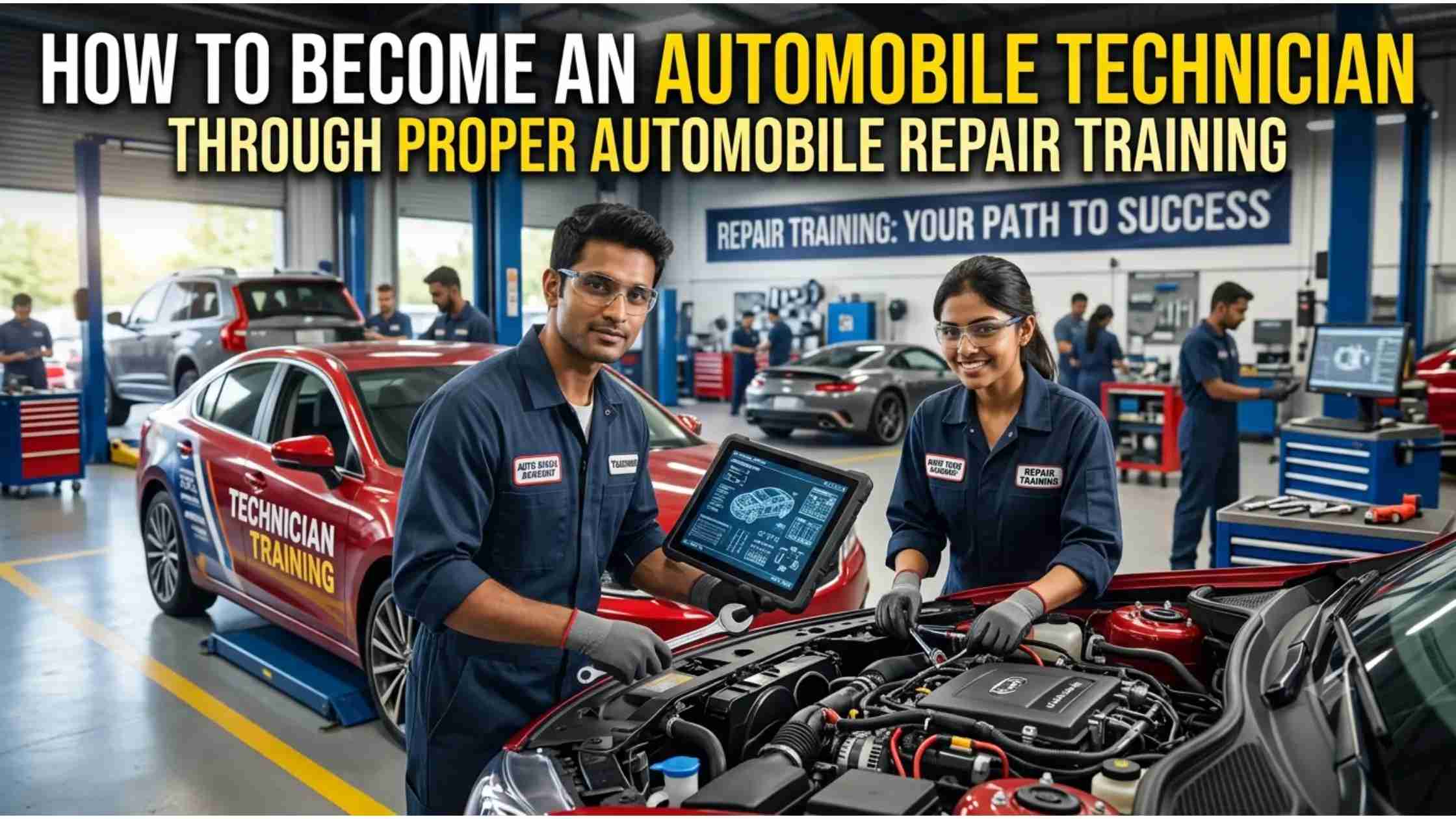
How to Become an Automobile Technician Through Proper Automobile Repair Training
The best way to become an automobile technician is simple: join proper automobile repair training. This is a hands-on course. You learn engines, brakes, suspension, and fault-finding. You get a certificate. You do real practical work.
It is not YouTube videos. It is not free work at a local garage. It is real vehicles. Real problems. A trained teacher fixes your mistakes early, before they cost a customer money.
India needs more skilled technicians today. New vehicles have BS-6 engines, computers, sensors, and electric parts. Just watching your uncle fix cars is not enough anymore.
This guide gives you easy answers. What skills you need. What qualification you need. How much time it takes. How much you can earn. And how to pick a good training institute..
What Skills Are Required to Become an Automobile Technician?
You need five things: mechanical knowledge, diagnostic thinking, basic electronics knowledge, precision, and the ability to talk to customers in simple words. No one comes into the world possessing these abilities. You build them through training.
Mechanical understanding. You need to truly understand how an engine works. Same for gearbox, suspension, and brakes. Not just the part names. When a car makes a strange sound or shakes, you find the cause. You start from the problem and work backward.
Diagnostic thinking. New vehicles show fault codes. They give sensor readings and scan tool data. A good technician does not just read the code and change a part. They understand what the code is really telling them.
Comfort with electronics. This is hard for many self-taught mechanics. Engine Control Modules, sensors, wiring, and onboard diagnostics are now a big part of automobile repair. They are not extra skills anymore. Basic electronics knowledge is now as important as using a spanner.
Patience and precision. Torque values, alignment angles, timing sequences — small mistakes here lead to big comebacks. Technicians who last in this trade are the ones who don't cut corners.
Customer communication. If you ever plan to run your own garage, being able to explain a problem in plain language to a worried vehicle owner is worth more than people realize.
Before you form negative habits on your own, structured auto repair training teaches you the proper technique for each of these.
What Qualifications Do You Need for Automobile Repair Training?
Most institutes accept students who have passed Class 10 or Class 12. A foundation in science is not required. You do not need good marks. What matters more is real interest and willingness to work with your hands.
Here is what you actually need:
- Real interest in vehicles and how they work
- Willingness to work with your hands, get dirty, and put in workshop hours
- Basic reading skill, since you will read manuals, wiring diagrams, and scan tool readings
- No electronics or mechanical knowledge is needed for beginner courses. A good course starts from the basics and builds up slowly
So if you are a school dropout, a graduate wanting a career change, or someone who has done manual labor for years and now wants a skilled trade, the door is open for you. What matters here is not the certificates you already have.You do not need a science background
How Long Does Automobile Repair Training Take?
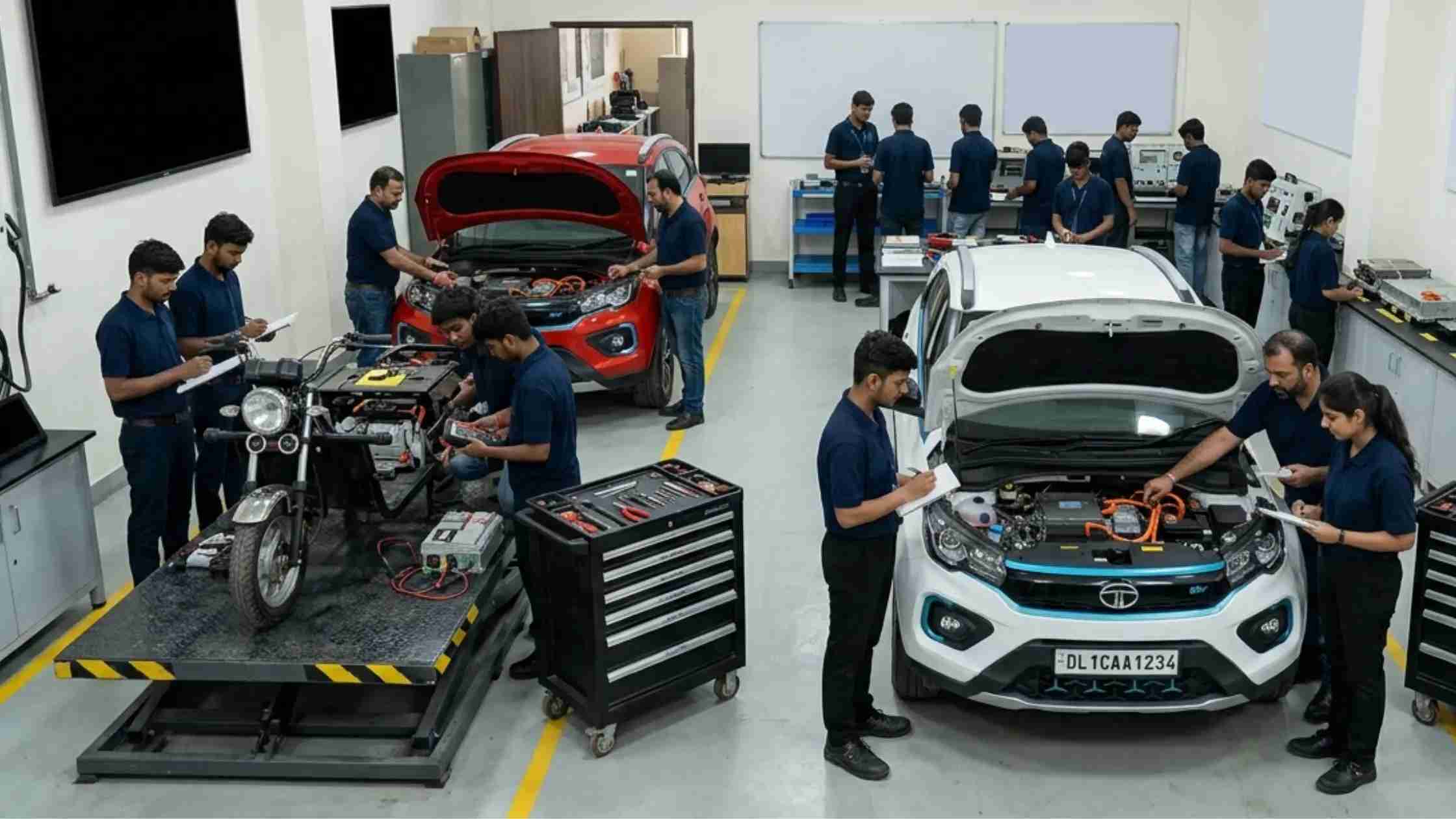
A good, hands-on automobile repair training program takes about 2 months. That is around 300 hours in total. Out of this, 80 hours are theory and 220 hours are practical work.
This means most of your time is spent working on real vehicles. Not sitting in a classroom.
This training covers the core basics: engines, steering, suspension, brakes, clutch, gearbox, cooling system, fuel system, and basic fault-finding. If you want to learn more, like ECM repair, EV systems, or vehicle electricals, these are separate courses. It's your main course, along with your main course.
Now contrast this with the traditional method of "learning on the job," which can take up to three years. And it is not structured. There is no guarantee you are learning the right way. Proper training saves you this time. It turns years of trial-and-error into just a couple of months.
What Are the Steps to Become a Certified Automobile Technician?
Enroll in a structured training program, complete the theory and practical hours, get certified, then take up an apprenticeship or entry-level job to build real-world speed.
The full roadmap, step by step:
-
Decide your specialization interest early. General mechanical repair is the foundation almost everyone should start with, since it covers engines, brakes, suspension, and drivetrain systems that every vehicle has.
-
Enroll in a structured automobile repair training program. Look for one with a genuine workshop, not just a classroom with posters of engines on the wall.
-
Complete the theory portion. Understand the "why" before the "how" - how combustion works, how a hydraulic brake system builds pressure, how a differential splits power between wheels.
-
Put in real practical hours. The real skill is developed here. Strip an engine down. Diagnose a real fault. Balance a wheel. Bleed a brake line. Repetition on real components is what separates a technician from someone who just watched it happen.
-
Get evaluated and certified. A recognized certificate from your training institute matters when you're applying for jobs - it tells an employer you've been tested, not just present.
-
Take up an apprenticeship or entry-level job. Even after certification, your first few months on a real shop floor under supervision will sharpen your speed and confidence.
-
Keep building specialized skills. Once you're comfortable with core mechanical work, adding ECM repair, EV servicing, or advanced electrical diagnostics to your skillset makes you far more valuable and opens the door to higher pay.
Do You Need a Degree to Become an Automobile Technician?
No. You do not need an engineering degree. You do not need a diploma. In most cases, you do not even need a completed 12th-grade certificate to start automobile repair training and build a career as a technician. This is one of the most easy-to-enter skilled trades there is.
This is a skill-based trade. Employers and customers care about one thing: can you fix a vehicle correctly? Your marksheet does not matter to them. If you do have a diploma in automobile or mechanical engineering, it can help you move faster into supervisor or manager roles later. But it is not needed to start earning as a technician.
What actually matters instead of a degree is your certificate from a good automobile repair training institute. Along with that, your practical hours and the skills you can show on a real vehicle matter too.
How Much Does an Automobile Technician Earn After Training?
Earnings depend on three things: your specialization, your location, and your experience. General entry-level technicians earn the least. Technicians with special skills earn more. Technicians who open their own shop have no earning limit at all.
Here is a closer look:
-
A fresh technician doing general mechanical repair at a local garage starts with an entry-level income. This grows as they build speed and confidence.
-
Technicians with special skills earn more than general mechanics. These special skills include ECM repair, vehicle electricals, EV servicing, and BS-6 diagnostics. Fewer people are trained in these areas, so the pay is higher.
-
Technicians in big cities usually earn more than those in small towns. But the cost of living is also higher in big cities.
-
Many trained technicians later open their own repair shops. Here, there is no salary limit. Their income depends on their customers and their reputation.
The real point is this: automobile repair training does not just get you a job. It gives you a skill you can keep growing. Every extra course you add on top of your training raises how much you can earn.
What Career Opportunities Are Available After Automobile Repair Training?
Automobile repair training opens many doors. It can lead to general mechanical repair jobs, ECM/ECU specialization, vehicle electrical repair, EV servicing, denting-painting, or your own garage. It is not just one job. It is a starting toolkit.
- General automobile and car repair shops. Doing daily mechanical servicing and repair.
- ECM and ECU repair specialization. A growing area as vehicles become more computer-based.
- Vehicle electrical repair. Working with wiring, sensors, and electrical faults.
- Instrument and meter repair. Working on dashboards and gauge systems.
- BS-6 compliant servicing. Working on today's emission-compliant engines.
- EV servicing and repair. A new and growing field as electric vehicles increase on Indian roads.
- Denting and painting. A good path if you like bodywork more than mechanical work.
- Starting your own repair business. Using your training as the base to run your own garage.
The main point is this: automobile repair training is not a dead-end skill. It is more like a starting toolkit. You keep adding to it based on where you want your career to go.
How to Choose the Right Automobile Repair Training Institute?
Check these things before you join any automobile repair training institute:
- A real hands-on workshop, not just classrooms
- Trainers with real work experience
- More practical hours than theory hours
- Clear and honest fees
- Accommodation help if you are relocating
- A government-recognized certificate
1. Look for a real workshop, not just a classroom
A training center that only talks about theory is not enough. It needs a proper workshop. It needs real engines, tools, and diagnostic equipment.
For example, at Hi-Tech Automotive Skills Development Academy in Khanna, Punjab, the whole program is built around a real workshop. It works like a real garage. Students use the same tools, engines, and equipment they will use on a real job. They do not just watch demonstrations.
2. Check who is teaching you
Ask how many years the trainer has worked in the automotive field. A trainer with real work experience teaches very differently from someone who only studied it in books. Real experience gives real insight.
3. Check the theory-to-practical ratio
A course full of lectures will not build real skill. Look for a program where more than half the hours are spent working on real vehicles, not sitting and listening.
4. Ask about accommodation, if you are relocating
If you are coming from another town or state, ask if the institute helps with stay and food. This matters more than people think. Settling-in stress can affect your focus during training.
As an example, institutes offering a room (with bed, fan, table, and attached bathroom) plus home-style meals usually charge around ₹6,500–₹7,000 per month for outstation students. Keep this in your budget along with the course fee.
5. Get clear pricing before you join
Course fees depend on duration, specialization, and how much practical work is included. Do not rely on guesswork or rumors. A good institute will clearly explain the fees, what is included, and any extra costs, over a call or in person.
6. Confirm the certificate is recognized
Ask directly: is the certificate government-approved? Will it help when applying to service centers or garages? A certificate that nobody recognizes will not help your job search much.
7. Check accessibility and affordability
Not everyone can afford to move to a big city for months of training. Institutes in smaller towns, like Khanna, Punjab, are often more affordable. Khanna is also easy to reach for students from nearby areas, including Ludhiana.
A real example to guide you:
Hi-Tech Automotive Skills Development Academy has trained students in automobile repair since 1970. Their program runs for 2 months, 300 hours total (80 hours theory, 220 hours practical). It covers engines, steering, brakes, suspension, and fault diagnosis.
They offer accommodation and meals for outstation students. They also give a government-approved certificate on completion. For exact current fees, call or WhatsApp them directly at +91-88726-46155, since pricing can change depending on which specialization you choose along with your core training.
Frequently Asked Questions
Is automobile repair training worth it in 2026?
Yes. Vehicles are becoming more technical every year, and demand for technicians who understand both mechanical systems and onboard electronics keeps growing. Structured training gets you job-ready faster than learning informally.
Can I do automobile repair training after 12th grade?
Yes, most programs accept students who've completed Class 10 or Class 12, and some accept candidates with even less formal education, as long as they're willing to put in the practical hours.
Do I need to know electronics before joining?
No. A well-structured beginner course starts from the basics, including foundational electronics where relevant, so prior knowledge isn't a requirement.
How is automobile repair training different from an engineering degree?
A degree focuses heavily on theory over several years. Automobile repair training focuses on practical, job-ready skills over a much shorter period, which is why it suits people who want to start earning sooner.
Where can I get quality automobile repair training in Punjab?
Hi-Tech Automotive Skills Development Academy in Khanna, Punjab offers hands-on automobile repair training with a dedicated workshop, experienced trainers, and accommodation support for outstation students. You can reach them at +91-88726-46155 for course details and current fees.